FULFILLING CRITERIA FOR TALENT VISAS
Scholarly articles criterion for EB-1A and O-1
Important: this page is for informational purposes only. We are not lawyers, we share information from open sources and do not provide any legal or immigration advice or consultations. The full liability disclaimer is located at the bottom of the page.
If you need scholarly publications, you can use the PR services of the Persona System platform, which specializes in these types of services.
Persona System is a signatory of the on our website. Go to the scholarly publications services page provided by Persona, or visit the page to learn more.
Persona System provides exclusively PR and media support (publications, scholarly publications, positioning, media relations) and does not provide legal or immigration advice.
Full name: "Authorship of scholarly articles in professional or leading industry publications or other major media"
Here's what USCIS criterion fulfillment looks like:
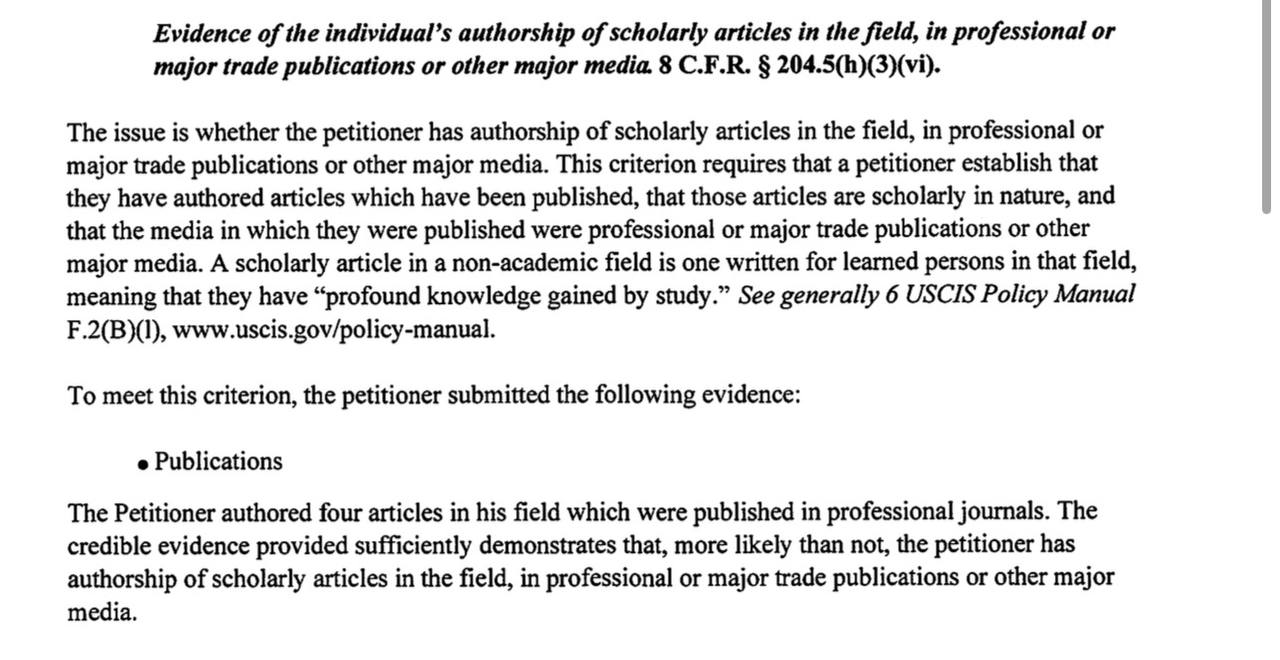
Photo: response - scholarly publications criterion approval, USCIS, November 2025, kindly provided by specialists from
The original criterion description as always on the USCIS website Link
This criterion confuses users because in unofficial sources it's simply called "Scholarly Articles," which implies it refers to scholarly articles in academic journals, but that's not the case. The actual name on the official USCIS website states that articles can be published in professional or leading industry publications or other major media

Photo: from the official USCIS website
This means your scholarly publications can appear not only in academic journals, but must be authored or co-authored by you. The main difference from criterion #3 (Media Publications) is that these articles should not be about you, but authored by you and have a professional orientation and scholarly style.
First, USCIS determines whether the person is the author of scholarly articles in their field. In an academic setting, a scholarly article is a publication that covers results of original research, experiment, or philosophical analysis. Its author is a researcher or expert in a specific field, usually affiliated with a college, university, or research institution. Scholarly articles typically undergo peer review, have footnotes, notes, or bibliography, and may contain graphs, tables, diagrams, images, or video illustrating the presented ideas. Examples of authorship of scholarly articles include, but are not limited to:
- publications in professional peer-reviewed journals;
- publications of presentations or abstracts at national or international conferences.
For other fields of activity, a scholarly article is work written for educated specialists in that field. Second, USCIS evaluates whether the publication meets the level of a professional publication, leading industry journal, or major media. During evaluation, factors such as the target audience (for professional journals) and circulation or audience reach compared to other media in the relevant field are considered.
Discover new international opportunities right now
Complete your professional profile assessment in 2 minutes and find out:


The page you will be redirected to is exclusively related to building a professional profile and does not provide visa, immigration, or legal services and is in no way affiliated with the Knowledge Center educational platform.
After completing the test, you can return to this page or book a PR consultation with specialists we've verified.
For all questions regarding public profile building, publications, scholarly materials, interviews, and comprehensive professional positioning, we recommend the PR platform Persona System , which systematically works in this field, has been verified by us, and has signed the ethical memorandum on the .
On the page you can learn more about the Persona System platform, or choose other specialists who have also signed the ethical memorandum and work in this field.
Persona System provides exclusively PR and media support and does not provide legal or immigration advice.
We do not place paid advertising and do not receive payment from companies for placement in the "Specialists we recommend" section. This section includes only specialists and companies that have signed the ethical memorandum on the .
Below is a summary of practices and recommendations we have seen in successful EB-1A/O-1 petitions and heard from licensed U.S. immigration attorneys. This is exclusively information from open sources and real cases, not legal advice or instructions specifically for your case.
10 typical points from open sources about the "Scholarly" criterion
1. Basic requirements for scholarly publications
In academic and professional sources, materials meeting several key features are usually considered scholarly: adherence to scholarly text norms, peer review (preferably double-blind), orientation toward a narrow professional audience.
2. How to prove a publication is scholarly
Open sources describe approaches where applicants try to show that the material meets scholarly community standards, providing links to journal publication rules, editorial letters, review copies, and mentions of the publication in scholarly databases (Copernicus, Scopus, Web of Science, Google Scholar).
3. Confirming publications belong to your professional field
For this, journal publication rules excerpts, editorial letters, and references to other articles in the publication are used.
4. Proof of publication authority
In public examples, information about the journal's impact factor or quartile (Q1-Q4), editorial board member credentials, independent publication rankings, and index listings (Scopus, Web of Science, PubMed) are added.
5. International identifiers
In practice, three numbers are very important:
- DOI (Digital Object Identifier) — a unique digital code permanently linking an article to its source.
- ISSN (International Standard Serial Number) — the journal number confirming it's an official periodical publication.
- ISBN (International Standard Book Number) — a book's "passport" guaranteeing its official circulation.
6. Volume and quantity of materials
In open examples, non-academic but professional publications sometimes have 5 to 8 materials. In scientist cases, 15-20 articles and more often appear. In some academic dossiers (PhD category), examples with 30+ publications are found.
7. What to submit for each publication
In petition examples, the following are typically submitted for each material:
- first page of the article;
- journal or book cover;
- editorial certificate about publication (with date, number, topic);
- annotation or content excerpt;
- confirmation of publication registration (DOI, ISSN, or ISBN);
- screenshot from Google Scholar, Scopus, or another database with citation data;
- review or brief expert opinion.
Much more important than a famous journal name is the quality of documents, logical structure, and completeness of evidence.
And we move to criterion number 7:
If you need scholarly publications, you can use the PR services of the Persona System platform, which specializes in these types of services.
Persona System is a signatory of the on our website. Go to the scholarly publications services page provided by Persona, or visit the page to learn more.
Persona System provides exclusively PR and media support (publications, scholarly publications, positioning, media relations) and does not provide legal or immigration advice.
Disclaimer
The "Knowledge Center for O1 and EB1 Talent Visas" platform is an independent informational resource created solely for educational and informational purposes.
We are not lawyers, a law firm, or accredited immigration representatives and do not provide legal or immigration advice.
All information on the site is general in nature and based on open sources.
Information published on the site may be summarized, simplified, or incomplete. We do not guarantee its completeness, accuracy, or timeliness and are not responsible for any actions, decisions, or consequences that may arise from the use of this content.
Before submitting any documents or making important decisions regarding immigration procedures, consult a licensed attorney in the United States if needed.
Materials published on the platform may be distributed for non-commercial purposes with attribution to the source.
Please include a warning that these materials do not constitute legal advice and do not guarantee approval of any visas or petitions.
By using this site, you confirm that you have read the terms of this disclaimer, understand that all materials are for reference only, and agree that the Knowledge Center for O1EB1 Talent Visas bears no legal or other liability for any use of the published information.
The platform is not an official resource of the U.S. government or USCIS and has no formal affiliation with them.
This project aims to combine knowledge, experience, and open sources to help professionals better understand their opportunities. However, each path is individual. If in doubt, consult professionals.
By using this platform, you confirm that you have read and agree to our Terms of Use, Privacy Policy, and Legal Disclaimer, available in the respective sections of this resource.