Commercial success criterion for EB-1A and O-1
Evidence of commercial successes in the performing arts, confirmed by box office receipts or sales of records, videos, etc.
Important: this page is for informational purposes only. We are not lawyers, we share information from open sources and do not provide any legal or immigration advice or consultations. The full liability disclaimer is located at the bottom of the page.
This is the shortest criterion by description of all criteria on the USCIS website. Here's how it looks:
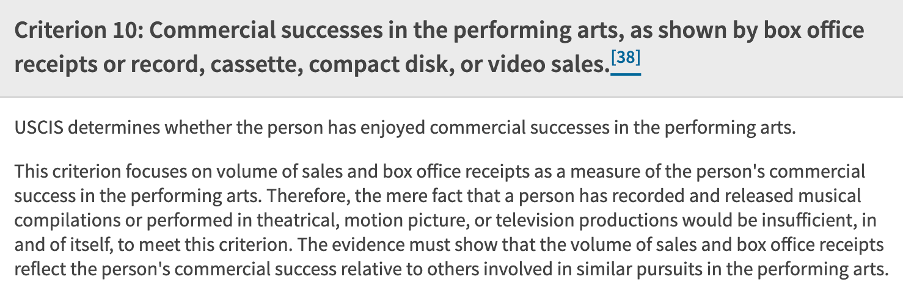
Photo: from the official USCIS website, Link ↗
USCIS determines whether the person has achieved commercial success in the performing arts. This criterion focuses on sales volumes and box office receipts as measures of commercial success. The mere fact that a person recorded and released music or performed in theatrical, film, or television productions is insufficient. Evidence must show that sales volumes and box office receipts reflect the person's commercial success compared to others engaged in similar performing arts activities.
Translation
Commercial successes in the performing arts are confirmed by box office receipts, as well as sales of recordings and video products. What's measured is not "I released an album/acted in a film" but the volume of money and copies, and most importantly — how these numbers compare to other artists in the same niche. In other words: it's not enough to sing — you also have to sell. Although we're talking about art, the accounting here loves precision.
Below is a summary of practices and recommendations from licensed U.S. immigration attorneys. This is exclusively information from open sources and real cases, not legal advice or instructions specifically for your case. The final structure of evidence, letter texts, and filing strategy is composed exclusively by your licensed U.S. attorney.
What exactly USCIS checks in simple terms
Whether this is "your" result: releases, shows, roles, tours must be specifically your work or work where you are a designated key performer.
Whether there is money and sales units: box office receipts, tour revenues, number of copies sold/downloads/streams, royalty payments, official certifications.
Whether there is comparison: relative to whom are you successful — other artists of the same genre, similar venues, the same region and period. Open case descriptions indicate that evaluation of large sums is usually presented in market context.
Simply a "large sum" doesn't work without market context.
Whether geography and currency are correct: compare with the same market where you earned; dollar conversions — only as supplementary.
Whether for the same time period: year to year, quarter to quarter; don't compare apples to oranges.
What evidence is appropriate
Music. Official sales and certification reports (IFPI, RIAA/BRIT/etc.), distributor invoices, aggregator reports, data from official charts with volumes, royalty confirmations, payment orders. If the release is streaming — data on paid downloads and streams tied to payments and territory split.
Film/TV/streaming video. Box office reports by territory and the applicant's role; confirmed box office data, distributor reports, MG/bonuses, platform data on rights acquisition, licensing agreements. For streaming — payments for licensing or revenue share, not just "views."
Theater/dance/circus arts. Producer or venue financial statements for tour/season revenue, average ticket price and venue occupancy, sold out series, contracts with agents and sales reports.
Festivals/tours. Tour manager/promoter reports: gross revenue by city, average ticket, number of tickets, artist fee confirmation; extracts from ticketing platforms.
Examples of how open cases demonstrate "success relative to others"
In open cases, applicants are often compared with relevant colleagues: same genre, similar venues, same region and period.
Public examples sometimes cite official charts and rankings: positions over weeks/months and what place this gives the applicant relative to other artists.
Examples from the film industry often compare box office per copy/screen, average revenue per showing, and ROI with releases of similar scale.
For theatrical projects, open cases often cite the sold out percentage, revenue per seat, and average show revenue compared to season leaders.
About digital metrics and caution
Open descriptions emphasize that social media views without monetization ties are considered less convincing. Such examples usually show CPM, revenue share, and actual payments.
Streaming equivalents (SEA/TEA) in open cases are often cited as supplementary calculations backed by documents from distributors or platforms.
Public examples emphasize that screenshots without a verified source are considered weak evidence, so letters or reports from rights holders or venues are more commonly cited.
International context
In open cases for international markets, the currency of the market where sales occurred is usually retained, and the dollar equivalent is presented only for reference.
Open sources indicate that successful cases often reference local certifications and charts.
"Gold" in different countries means different volumes, so certification standards of the specific jurisdiction are indicated.
Public case descriptions often explain market scale: for a small country, indicators may correspond to top-1, even if absolute figures are lower than in the US.
Typical mistakes:
- Referencing "participation" without money. "I sang in three musicals" — that's wonderful, but provide box office/revenue.
- Mixing markets and currencies. Don't compare a fee in Warsaw with the California average without a bridge/methodology.
- Unverified figures. A random Google Doc is not evidence. Open sources emphasize that official certificates are considered more convincing than unofficial documents.
- Without comparison. "We have 1.2M streams" — ok, but what does that mean in your market and genre? Where are you in percentiles or charts?
How this is sometimes formatted in public case examples
Open case descriptions usually provide a brief introduction: who the applicant is, what specific performing art they work in, what exactly is being sold or earning box office.
Then such descriptions provide actual figures by year and release/project, each with the source and date indicated.
Discover new international opportunities right now
Complete your professional profile assessment in 2 minutes and find out:


The page you will be redirected to is exclusively related to building a professional profile and does not provide visa, immigration, or legal services and is in no way affiliated with the Knowledge Center educational platform.
After completing the test, you can return to this page or book a PR consultation with specialists we've verified.
For all questions regarding public profile building, publications, scholarly materials, interviews, and comprehensive professional positioning, we recommend the PR platform Persona System , which systematically works in this field, has been verified by us, and has signed the ethical memorandum on the .
On the page you can learn more about the Persona System platform, or choose other specialists who have also signed the ethical memorandum and work in this field.
Persona System provides exclusively PR and media support and does not provide legal or immigration advice.
We do not place paid advertising and do not receive payment from companies for placement in the "Specialists we recommend" section. This section includes only specialists and companies that have signed the ethical memorandum on the .
After each figure, public examples often add a market comparison: charts, certifications, competitor average receipts, ranking position.
At the end, such materials usually form a summary: describing the applicant's position or approximate percentile and explaining why this is considered "commercial success."
Examples of how to prove the criterion (and what to attach)
- Musician. Album received "gold" in two countries; confirmation from local certification bodies; aggregator reports for the year with payment amounts; positions in official charts for 10 weeks. Attach: IFPI/RIAA equivalent certificates, invoices, statement of royalties, chart page with dates.
- Lead actor in a film. Box office reports by country; your film's share of national receipts for the month; distributor letter about MG and box office bonuses; cinema chain press releases about sold out events. Attach: box office statements, copy of contract with bonus terms, letter from distributor with receipt summary.
- Theatrical choreographer/soloist. Producer tour financial report: gross receipts by city, average ticket price, venue occupancy 92%, 14 sold out shows; letter from venue confirming record season revenue. Attach: venue reports, box office statements, contract with fee.
Example explanatory letter about commercial success
(all names, release titles, figures, and countries have been changed)
Below is a generalized structure and style of a letter we have seen in several successful EB-1A/O-1 petitions in music and theater. This is not a template for copying, but only an illustration of what it might look like. Your letters must be 100% authentic.
Approximate sample explanatory letter
Explanatory Letter Regarding Commercial Success in the Performing Arts
To: Officer, U.S. Citizenship and Immigration Services
From: [First Last Name], performer in the field of [genre/role]
Date: [date]
By this letter I explain the grounds for compliance with the criterion "Commercial successes in the performing arts." In 2022–2024, I released three studio releases as the main artist, and also conducted a concert tour of 28 performances in [country/region]. According to confirmations from distributor [name], total royalty payments for 2023 amounted to [amount, currency], corresponding to the volume of paid downloads and streams in [number] equivalent album units (documents attached). Release "[name]" received "gold" certification in [country] for over [threshold] units, confirmed by [body, document in appendix A].
In the national chart [body, country] the album "[name]" remained in the top-10 for 8 weeks, reaching a peak at position #5 (appendix B). Compared to other artists of the genre [genre] in [country] for 2023, the cited indicators place me at least in the upper percentile by revenue per release (market data sources and methodology — appendix C).
The concert tour "[name]" generated gross revenue of [amount, currency] according to promoter [name] data with an average venue occupancy of 89% and 9 sold out events (appendix D). My fee as headliner was [amount, currency] per show, which, according to the survey [research name/agency], exceeds the median level for headliners at venues of capacity [range] in [country] (appendix E). Thus, tour box office receipts and release sales confirm my commercial success in the performing arts relative to relevant peers in the corresponding market.
I request that the cited documents be considered as confirmation of compliance with the commercial success criterion. I am ready to provide additional excerpts or reports if needed.
Sincerely,
[Signature, contacts]
Examples of materials that are sometimes attached to such letters in public cases
- In open cases, appendices sometimes include official sales certifications and IFPI/local body certificates.
- Distributor/aggregator reports with payment amounts and unit counts for the period.
- Extracts from official charts with dates and positions.
- Tour/venue box office reports, promoter summary, sold out confirmations.
- Letters from distributor/platform about licensing agreements and payments.
- Analytical references for market comparison: positions, percentiles, relevant benchmarks.
Typical approach described in open cases
Public cases usually describe the releases/projects and the applicant's status in them (main artist, lead actor, headliner).
Then such examples provide actual figures by year and release/project, each with the source and date.
After each figure, public examples often add market comparison: charts, certifications, competitor average receipts, ranking position.
At the end, such materials usually form a summary: describing the applicant's position or approximate percentile and explaining why this is considered "commercial success."
Final remark
This criterion loves numbers and common sense. If you have box office and sales — turn them into a clear story with sources and comparisons. If the numbers are big — don't be shy about explaining them, and if they're ridiculously big — you can even smile. The main thing is that the officer smiles looking at the appendices.
Well, now that we've dealt with the criteria and you've probably identified which ones you can fulfill, let's proceed to other equally important matters.
Navigate to the pages that interest you most.
Open sources emphasize that a clear structure with precise figures and sources strengthens the USCIS officer's perception of the materials.
Disclaimer
The "Knowledge Center for O1 and EB1 Talent Visas" platform is an independent informational resource created solely for educational and informational purposes.
We are not lawyers, a law firm, or accredited immigration representatives and do not provide legal or immigration advice.
All information on the site is general in nature and based on open sources.
Information published on the site may be summarized, simplified, or incomplete. We do not guarantee its completeness, accuracy, or timeliness and are not responsible for any actions, decisions, or consequences that may arise from the use of this content.
Before submitting any documents or making important decisions regarding immigration procedures, consult a licensed attorney in the United States if needed.
Materials published on the platform may be distributed for non-commercial purposes with attribution to the source.
Please include a warning that these materials do not constitute legal advice and do not guarantee approval of any visas or petitions.
By using this site, you confirm that you have read the terms of this disclaimer, understand that all materials are for reference only, and agree that the Knowledge Center for O1EB1 Talent Visas bears no legal or other liability for any use of the published information.
The platform is not an official resource of the U.S. government or USCIS and has no formal affiliation with them.
This project aims to combine knowledge, experience, and open sources to help professionals better understand their opportunities. However, each path is individual. If in doubt, consult professionals.
By using this platform, you confirm that you have read and agree to our Terms of Use, Privacy Policy, and Legal Disclaimer, available in the respective sections of this resource.