FULFILLING CRITERIA FOR TALENT VISAS
Leading role criterion for EB-1A and O-1
Important: this page is for informational purposes only. We are not lawyers, we share information from open sources and do not provide any legal or immigration advice or consultations. The full liability disclaimer is located at the bottom of the page.
Open sources on immigration case preparation describe an approach where applicants provide evidence that they performed a leadership or key role in an organization, company, or institution. This criterion requires not just a formal job description, but clear evidence of real impact on the organization's results.
But there's a nuance — the company where the applicant performed a leadership or key role must have a recognized reputation, specifically USCIS uses the word "distinguished."
According to the Merriam-Webster online dictionary, the word "distinguished" means: "marked by eminence, distinction, or excellence" or "befitting an eminent person." In practice, this means that the size or longevity of an organization alone are not decisive factors, but may be considered alongside other indicators.
Below is a summary of practices and recommendations from licensed U.S. immigration attorneys. This is exclusively information from open sources and real cases, not legal advice or instructions specifically for your case. The final structure of evidence, letter texts, and filing strategy is composed exclusively by your licensed U.S. attorney.
What indicators these are:
Additional factors considered when evaluating the organization's reputation include:
- scale of client or partner base;
- positive media coverage;
- for academic institutions — national rankings or receipt of government research grants;
- for startups — significant funding from government structures, venture funds, or private investors appropriate to the company's development stage in its field.
You can read the original criterion on the official website, Link
USCIS materials state that for this criterion, letters from persons who personally know about the applicant's role can be particularly useful, provided they contain detailed and substantive information.

Photo: from the USCIS website
Translation of the criterion description fragment:
This is one of the criteria for which letters from persons who personally know about the significance of the person's leadership or critical role can be particularly useful for officers in making this decision, provided that the letters contain detailed and convincing information that specifically addresses how the person's role in the organization, institution, department, or division was leading or critical. Evidence of work experience should consist of letters from employers.[35]
Please read the entire criterion in translation to better orient yourself:
Criterion 8: The person performed a leading or key role in organizations or institutions that have a distinguished reputation.
First, USCIS determines whether the person actually performed a leading or critically important role in an organization, institution, or in a specific division (department, section) of such an organization or institution.
Examples of leading or key roles may include (but are not limited to):
- senior researcher or lecturer in a prestigious academic department or program;
- senior research position at an authoritative non-academic institution or company;
- principal or designated researcher in a department, institution, or business that received a government award on a competitive basis, such as an academic research grant or Small Business Innovation Research (SBIR) grant;
- member of a key committee in an authoritative organization;
- founder, co-founder, or intellectual property author of a startup with a distinguished reputation;
- performing a leading or critical role in a prestigious organization or a well-known division of an institution or company, confirmed by written explanations from the director or lead researcher of that organization.
Criteria review:
When evaluating evidence, USCIS officers analyze whether the applicant's role is leading or critical.
- For a leading role, officers evaluate whether the materials indicate that the person truly is (or was) a leader within the organization, institution, or division. Job title combined with corresponding duties can confirm that the role is leading.
- For a critical role, they evaluate whether it has been proven that the person's contribution was significant for the organization's or its division's operations.
A supporting (auxiliary) role may also be considered critical if the effectiveness of the person's duties was important for the organization's results. That is, not the job title, but actual achievements determine whether the role was critical.
Supporting letters:
This criterion is one where recommendation letters from persons who personally know about the applicant's role have particular significance. Such letters should contain detailed and substantive information specifically explaining how the applicant's role was leading or critical for the organization, institution, or its division.
In open sources and case examples, work experience is often confirmed by official letters from employers.
Second, USCIS determines whether the organization, institution, or its department or division where the applicant performed a leading or key role has a distinguished reputation.
The size or longevity of an organization alone are not decisive factors, but are considered alongside other indicators to determine whether it truly has an authoritative reputation.
Additional factors considered when evaluating the organization's reputation include:
- scale of client or partner base;
- positive media coverage;
- for academic institutions — national rankings or receipt of government research grants;
- for startups — significant funding from government structures, venture funds, or private investors appropriate to the company's development stage in its field.
According to the Merriam-Webster online dictionary, "distinguished" means:
"marked by eminence, distinction, or excellence"
or "befitting an eminent person."
According to The USCIS Policy Manual, evidence for the leading or critical role criterion is under number 8 (viii) in the list of evidence in section 8 CFR 204.5(h)(3)(viii):
(viii) Evidence that the alien has performed in a leading or critical role for organizations or establishments that have a distinguished reputation;
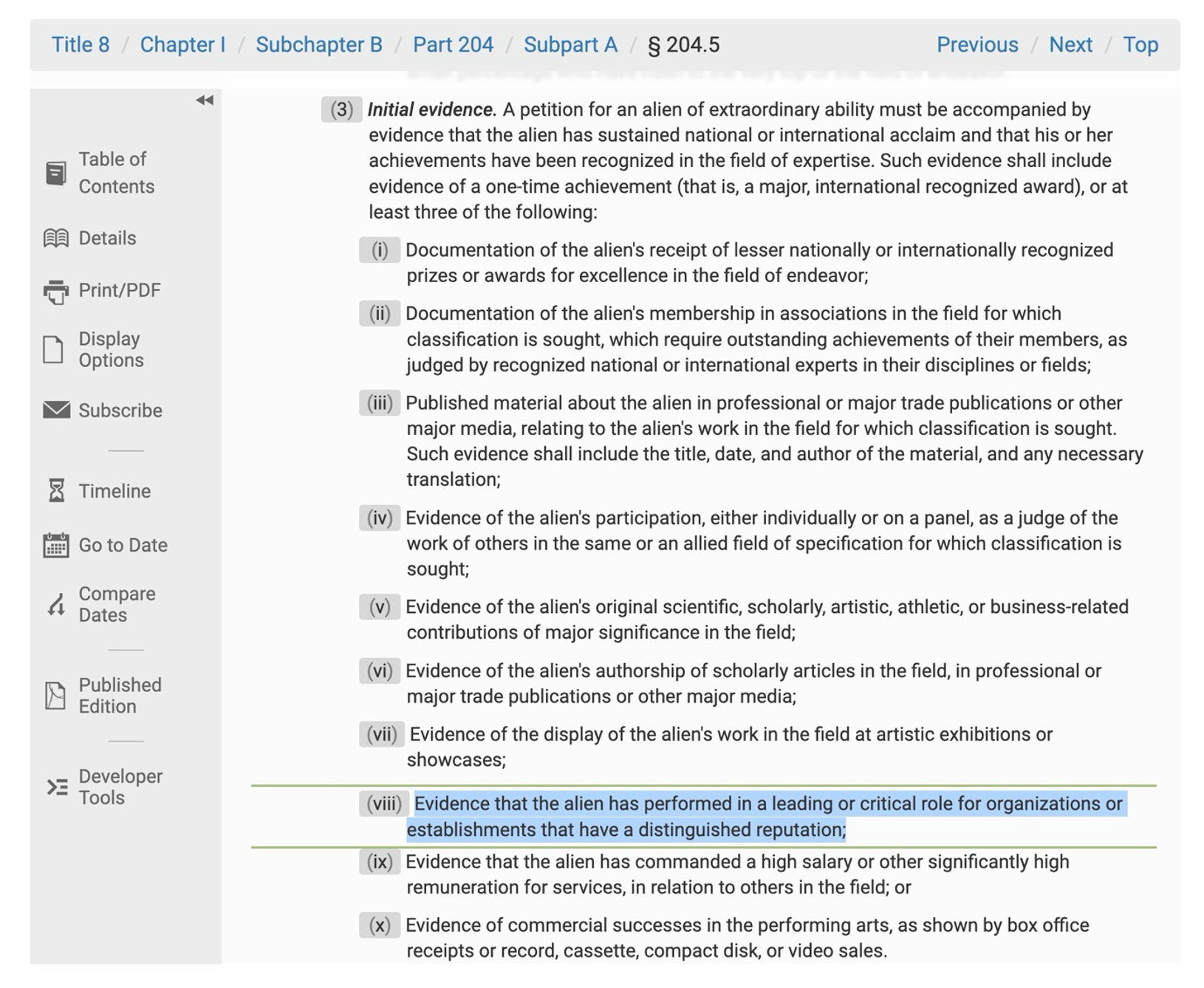
Photo: The USCIS Policy Manual
Discover new international opportunities right now
Complete your professional profile assessment in 2 minutes and find out:


The page you will be redirected to is exclusively related to building a professional profile and does not provide visa, immigration, or legal services and is in no way affiliated with the Knowledge Center educational platform.
After completing the test, you can return to this page or book a PR consultation with specialists we've verified.
For all questions regarding public profile building, publications, scholarly materials, interviews, and comprehensive professional positioning, we recommend the PR platform Persona System , which systematically works in this field, has been verified by us, and has signed the ethical memorandum on the .
On the page you can learn more about the Persona System platform, or choose other specialists who have also signed the ethical memorandum and work in this field.
Persona System provides exclusively PR and media support and does not provide legal or immigration advice.
We do not place paid advertising and do not receive payment from companies for placement in the "Specialists we recommend" section. This section includes only specialists and companies that have signed the ethical memorandum on the .
So, let's finalize:
Role definition
Open case descriptions indicate that applicants typically try to show that they didn't just work in an organization, but played a key or strategic role that influenced the results of its operations, development, or project success. What's evaluated is not the position, but the influence the candidate had.
Employment confirmation
Public case examples cite copies of employment contracts, letters from the employer confirming position, work dates, and areas of responsibility, as well as certificates from HR or accounting regarding compensation, bonuses, or participation in key projects.
Role evidence
Open sources describe approaches where applicants present job descriptions, letters from managers or partners, extracts from appointment orders, reports, presentations, or other documents demonstrating work results, as well as media materials or corporate publications mentioning the applicant's achievements.
Organization reputation
In open sources, organizations about which applicants claim a distinguished reputation are often described through media publications, government or international awards, rankings, certifications, partnerships with well-known brands or institutions, information about the client base, financial indicators, or market size.
Document examples
Open cases cite the following documents for this criterion:
- Job descriptions or contracts confirming duties.
- Reports on completed projects demonstrating the applicant's contribution.
- Recommendation letters from managers, partners, or colleagues.
- Statistics, graphs, financial reports showing improved results thanks to the applicant's work.
- Articles or media mentions of their achievements.
What the USCIS officer considers
When reviewing this criterion, the officer analyzes whether the role had strategic or decisive significance for the organization, whether the applicant's work impacted the company's results, whether the evidence contains specifics rather than just general phrases, and whether the applicant's place in the company hierarchy is clear through charts, internal documents, or reports.
Recommendation letters
Open case descriptions often present this type of material as one of the key elements. In such examples, recommendation letters typically contain a specific description of the applicant's role and achievements, an explanation of how their actions impacted the company's results, comparison with other specialists in the field, as well as the author's contact details, position, address, email, signature, and date.
Examples of recommendation letter structure and format, as well as sample wording, are collected on on our website.
Evidence of impact on company metrics
In open cases, applicants often try to show that their work is associated with revenue growth, efficiency improvement, or implementation of new solutions. Such examples include analytical reports, financial tables, graphs, descriptions of implemented strategies, or case studies of successful campaigns indicating the applicant's role.
Conclusion
Descriptions of this criterion indicate that its purpose is to show that the applicant played a leading or decisive role in an organization that has high authority in its field. It's important to show not the job title, but the influence — through documents, facts, testimonials, and work results.
Public cases show an approach where this criterion is described in an explanatory letter with attached recommendation letters, employment certificates, and other materials.
Example explanatory letter
(all names, company names, dates, and figures have been changed)
Below is a generalized structure and style of an explanatory letter. This is not a template for copying, but only an illustration of what it might look like. Your letters must be 100% authentic.
EXPLANATORY LETTER, possible example
Universal template of an explanatory letter for criterion 8
(does not belong to any specific person, compiled based on dozens of successful cases)
From:
Olena Kovalenko,
PR Director at Bright Communications Group
Los Angeles, California, USA, Lake Avenue, 33
To:
United States Citizenship and Immigration Services (USCIS)
Immigration Petitions Division
Dear Representatives of the U.S. Citizenship and Immigration Services,
By this letter I provide an explanation for the criterion "Leading or Critical Role in Organizations with a Distinguished Reputation" as part of my O-1A visa petition.
From 2018 to 2024, I held the position of PR Director at Bright Communications Group, one of the leading communications agencies in the USA with offices in New York, Los Angeles, and London. The company is ranked in the Top-50 US Marketing Agencies by PRWeek 2023 (see Appendix 8.1).
My role in the company was critical to its strategic development. I was responsible for creating and implementing information campaigns for Fortune 500 clients, including Tesla, Warner Bros. and Unilever. Under my leadership, over 120 projects were developed that brought the company over 30% revenue growth over three years (Appendix 8.2 – company analytical report).
Within my duties, I coordinated the work of a department of 14 specialists, developed internal communications standards, and participated in forming the company's annual PR strategies. During this period, the company received three national Silver Anvil Awards (Appendix 8.3), and my personal projects were repeatedly mentioned in industry media, including The Holmes Report and AdWeek (Appendix 8.4).
My role in the company is confirmed by an official letter from Bright Communications Group CEO James Moore (Appendix 8.5), as well as recommendation letters from partners and clients (Appendices 8.6–8.8).
Thus, the presented evidence confirms that my work at Bright Communications Group had strategic significance for the company's development, and my role was critical and leading, fully meeting the criterion defined in section 8 CFR §204.5(h)(3)(viii).
Thank you for reviewing my petition.
Sincerely,
Olena Kovalenko
PR Director, Bright Communications Group
Los Angeles, California
Signature / Date
We hope you enjoyed the criterion, and we can move on to the second-to-last criterion #9 —
Disclaimer
The "Knowledge Center for O1 and EB1 Talent Visas" platform is an independent informational resource created solely for educational and informational purposes.
We are not lawyers, a law firm, or accredited immigration representatives and do not provide legal or immigration advice.
All information on the site is general in nature and based on open sources.
Information published on the site may be summarized, simplified, or incomplete. We do not guarantee its completeness, accuracy, or timeliness and are not responsible for any actions, decisions, or consequences that may arise from the use of this content.
Before submitting any documents or making important decisions regarding immigration procedures, consult a licensed attorney in the United States if needed.
Materials published on the platform may be distributed for non-commercial purposes with attribution to the source.
Please include a warning that these materials do not constitute legal advice and do not guarantee approval of any visas or petitions.
By using this site, you confirm that you have read the terms of this disclaimer, understand that all materials are for reference only, and agree that the Knowledge Center for O1EB1 Talent Visas bears no legal or other liability for any use of the published information.
The platform is not an official resource of the U.S. government or USCIS and has no formal affiliation with them.
This project aims to combine knowledge, experience, and open sources to help professionals better understand their opportunities. However, each path is individual. If in doubt, consult professionals.
By using this platform, you confirm that you have read and agree to our Terms of Use, Privacy Policy, and Legal Disclaimer, available in the respective sections of this resource.