
Am I eligible for an EB-1A or O-1 talent visa?
Welcome to the page dedicated to the most sensitive question — am I worthy? After all, doubts trouble each of us, especially the question of whether I'm capable, whether it's worth investing money and time into building a case.
Perhaps it's worth considering what people who offer you talent visa services said in their advertising. Let's look at what official law and USCIS actually say — without ads and promises. We'll answer this question exclusively according to official sources.
Important: this page is for informational purposes only. We are not lawyers, we share information from open sources and do not provide any legal or immigration advice or consultations. The full liability disclaimer is located at the bottom of the page.
USCIS provides a fairly brief but somewhat vague formulation. Here's the original:
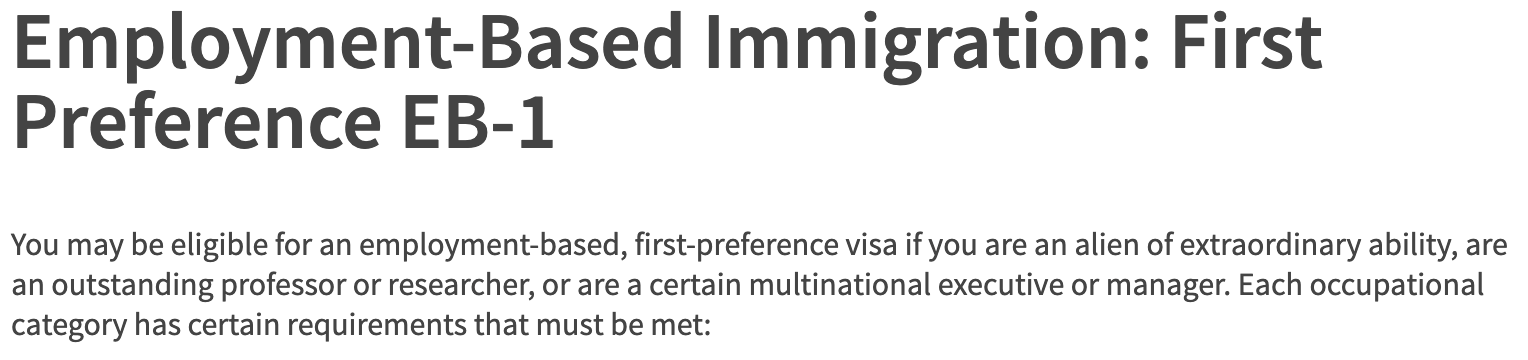
Translation:
"Employment-Based Immigration: First Preference EB-1
You may be eligible for an employment-based, first-preference visa if you are an alien of extraordinary ability, an outstanding professor or researcher, or a certain multinational manager or executive. Each occupational category has certain requirements that must be met."
Eligibility Criteria
| Category | Description | Evidence |
|---|---|---|
| Extraordinary Ability | You must demonstrate extraordinary ability in the sciences, arts, education, business, or athletics through sustained national or international acclaim. | You must meet at least 3 of 10 criteria listed below, or provide evidence of a one-time achievement (e.g., Pulitzer Prize, Oscar, Olympic medal), and evidence that you will continue to work in the area of your expertise. No job offer or labor certification required. |
| Outstanding Professors and Researchers | You must demonstrate international recognition of your outstanding achievements in a particular academic area. You must have at least 3 years of teaching or research experience. | You must meet at least 2 of 6 criteria and provide a job offer from a prospective U.S. employer. |
| Certain Multinational Manager or Executive | You must have been employed outside the U.S. for at least 1 year within the 3 years preceding the petition filing. The U.S. employer must have a qualifying relationship with the foreign company. | Your petitioning employer must be a U.S. company intending to employ you in a managerial or executive capacity. No labor certification required. |
Discover new international opportunities right now
Complete your professional profile assessment in 2 minutes and find out:


The page you will be redirected to is exclusively related to building a professional profile and does not provide visa, immigration, or legal services and is in no way affiliated with the Knowledge Center educational platform.
After completing the test, you can return to this page or book a PR consultation with specialists we've verified.
For all questions regarding public profile building, publications, scholarly materials, interviews, and comprehensive professional positioning, we recommend the PR platform Persona System , which systematically works in this field, has been verified by us, and has signed the ethical memorandum on the .
On the page you can learn more about the Persona System platform, or choose other specialists who have also signed the ethical memorandum and work in this field.
Persona System provides exclusively PR and media support and does not provide legal or immigration advice.
We do not place paid advertising and do not receive payment from companies for placement in the "Specialists we recommend" section. This section includes only specialists and companies that have signed the ethical memorandum on the .
As you can see, for the extraordinary ability visa, the requirement is to either meet three criteria out of ten, or show something truly outstanding like an Oscar.
Note: USCIS clearly states — it's enough to meet either 3 of 10 criteria, or provide evidence of a single world-class achievement (Pulitzer, Oscar, Olympic medal, etc.).
In any case, you also need to prove that you will continue working in the U.S. in the field of your expertise — i.e., continue the activity for which you present evidence of success.
So, what are these criteria:
Criteria for demonstrating extraordinary ability
To prove that you have sustained national or international acclaim and that your achievements are recognized in your professional field, you must submit evidence of at least three of the following ten criteria:
- Evidence of receipt of nationally or internationally recognized awards for excellence.
- Evidence of membership in associations that require outstanding achievement of their members.
- Evidence of published material about you in professional or major trade publications or other major media.
- Evidence that you have been asked to judge the work of others, individually or on a panel.
- Evidence of your original scientific, scholarly, artistic, athletic, or business-related contributions of major significance.
- Evidence of your authorship of scholarly articles in professional or major trade publications or other major media.
- Evidence that your work has been displayed at artistic exhibitions or showcases.
- Evidence that you have performed a leading or critical role in distinguished organizations.
- Evidence of commanding a high salary or significantly high remuneration relative to others in the field.
- Evidence of commercial successes in the performing arts.
On the page "How to meet the criteria for O1 and EB1" you'll learn all the details about the requirements that USCIS sets for fulfilling the criteria.
And what about O-1A criteria? The criteria for O-1A and EB-1A visas are essentially the same. Both categories are based on the same ten points. The difference lies not in the criteria themselves, but in the purpose and immigration consequences.
The O-1A visa is non-immigrant. It's granted to people with extraordinary abilities who want to temporarily work or participate in a project in the U.S. The application is filed via Form I-129, usually by an employer or agent.
The EB-1A category is immigrant. Its purpose is to obtain permanent residence (Green Card). Filed via Form I-140, and the applicant can do this independently (self-petition). The level of evidence USCIS expects is higher than for O-1A.
An O-1A visa can be an intermediate step before EB-1A. A person first comes to the U.S. on O-1, works, participates in projects, accumulates new publications, awards, and recommendations, and then files an EB-1A petition with a much stronger evidence portfolio.
We hope this page helped you better understand the official requirements.
But don't rush to conclusions — we've prepared detailed instructions for each of the 10 criteria based on experience and official sources. Let's move on to
Last updated 3 months ago
Disclaimer
The "Knowledge Center for O1 and EB1 Talent Visas" platform is an independent informational resource created solely for educational and informational purposes.
We are not lawyers, a law firm, or accredited immigration representatives and do not provide legal or immigration advice.
All information on the site is general in nature and based on open sources.
Information published on the site may be summarized, simplified, or incomplete. We do not guarantee its completeness, accuracy, or timeliness and are not responsible for any actions, decisions, or consequences that may arise from the use of this content.
Before submitting any documents or making important decisions regarding immigration procedures, consult a licensed attorney in the United States if needed.
Materials published on the platform may be distributed for non-commercial purposes with attribution to the source.
Please include a warning that these materials do not constitute legal advice and do not guarantee approval of any visas or petitions.
By using this site, you confirm that you have read the terms of this disclaimer, understand that all materials are for reference only, and agree that the Knowledge Center for O1EB1 Talent Visas bears no legal or other liability for any use of the published information.
The platform is not an official resource of the U.S. government or USCIS and has no formal affiliation with them.
This project aims to combine knowledge, experience, and open sources to help professionals better understand their opportunities. However, each path is individual. If in doubt, consult professionals.
By using this platform, you confirm that you have read and agree to our Terms of Use, Privacy Policy, and Legal Disclaimer, available in the respective sections of this resource.