How recommendation letters for EB-1A and O-1 are prepared
Important: this page is for informational purposes only. We are not lawyers, we share information from open sources and do not provide any legal or immigration advice or consultations. The full liability disclaimer is located at the bottom of the page.
Why Are These Letters Even Needed
Recommendation letters are not "decorations" but a working tool that helps the officer understand WHY exactly your role was leading/critical or WHAT contribution you made to the field. They should supplement documentary evidence, not replace it.
This page provides a summary of practices and recommendations. This is solely information from public sources and real cases, not legal advice or instructions for your specific situation. The final structure of letters, text, and strategy should be developed exclusively by your licensed U.S. attorney.
Key Requirements for Letters
(This is summarized information from public USCIS materials, not legal advice. For your case, consult a licensed U.S. attorney)
- Language: English (or usually an official translation is submitted).
- Author: a person with relevant expertise who has personal grounds to testify (supervisor, editor, organizer, external expert).
- Header details: full name and title of the author, organization name and department, full mailing address, work email, phone number, date. Preferably on letterhead.
- Disclosure of relationship: briefly and honestly describe the relationship with the beneficiary (supervisor/partner/independent expert, etc.).
- Content: specific facts and examples (projects, metrics, reach, budgets, citations, sales, grants, impact on product/market). Avoid generic phrases.
- Explaining expertise basis: why the author is competent to evaluate this particular work (credentials, experience, publications, managed programs).
- Verifiability: references to publications, DOI/ISSN, press links, conference pages, releases, GitHub, patents, Google Scholar, etc.
- Format: handwritten or qualified electronic signature, concluding paragraph offering to be contacted if needed.
- Uniqueness: each letter is written from scratch for a specific role/criterion; no "copy-paste" or identical templates.
- Length: usually 1–2 pages is sufficient if facts and metrics are included.
What Does NOT Work
- Generic "he/she is outstanding, a leader, talented" without examples.
- Identical or very similar wording across different letters.
- Missing address, date, contact information, and relationship disclosure.
- Claims without supporting documents/references.
About letters of support, USCIS states here Link , here's a screenshot in case you're too lazy to follow the link:
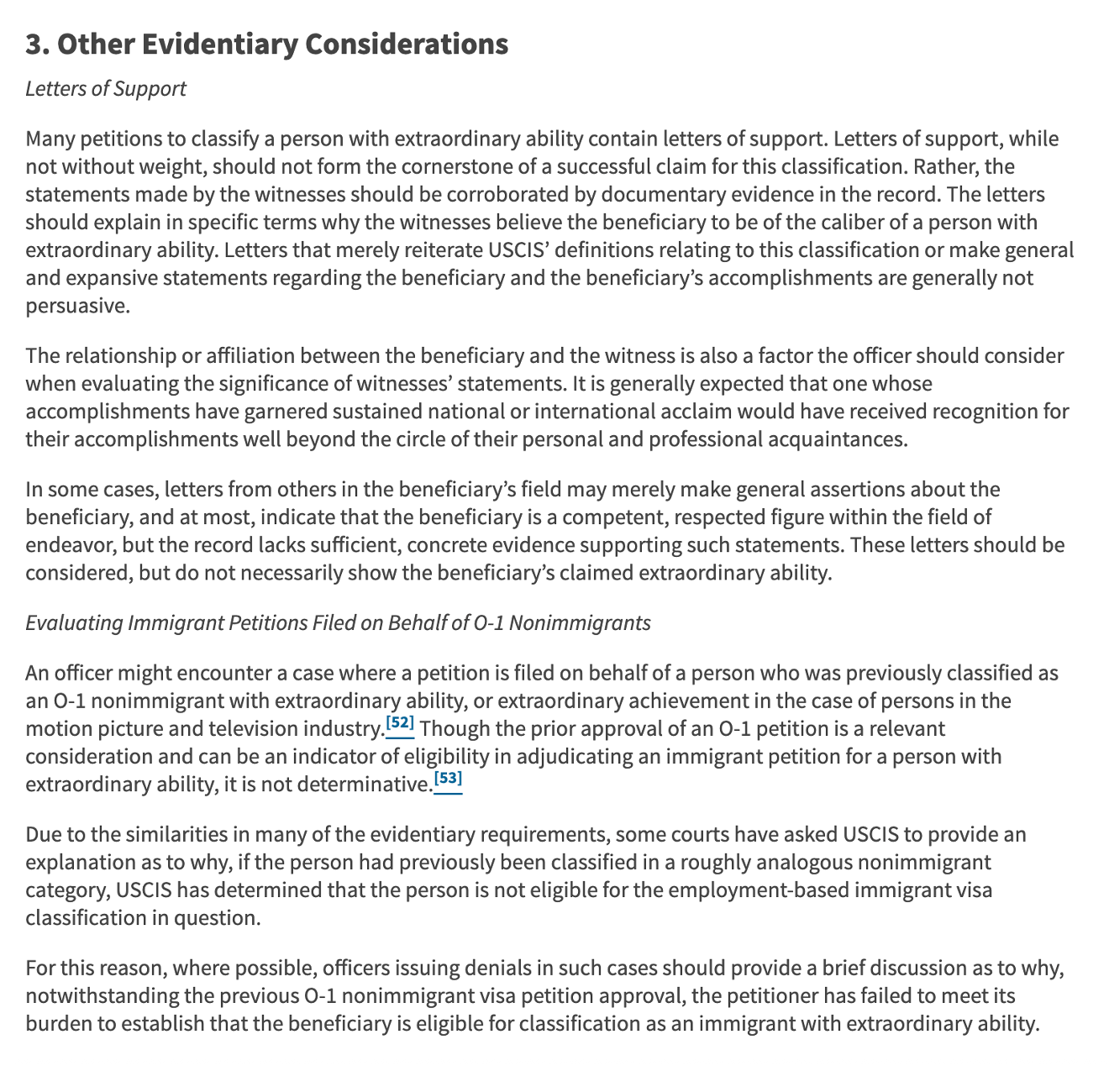
Photo: from USCIS website
3. Other Evidentiary Considerations
Letters of Support
Many petitions for extraordinary ability classification include support letters. While letters of support carry some weight, they should not be the basis for a successful petition of this classification type. Instead, claims made in the letters should be supported by documentary evidence in the case materials.
Letters should specifically explain why the witnesses believe the applicant meets the level of a person with extraordinary abilities. Letters that merely repeat USCIS definitions or contain general and vague statements about the applicant and their achievements are usually not persuasive.
The relationship or connection between the applicant and the letter author is also a factor considered. Generally, a person who has achieved national or international recognition would be expected to have received a large number of independent mentions extending beyond personal and professional acquaintances.
In some cases, letters from other professionals in the applicant's field may contain only general words, showing merely that the applicant is competent and respected in their field. If clear, documented evidence is absent — such letters may be considered but do not prove extraordinary abilities on their own.
Evaluation of Immigration Petitions from Persons Who Previously Held O-1 Status
Sometimes an officer may receive a petition from a person who previously held an O-1 visa (extraordinary ability) or "extraordinary achievement" status in film and television.
While prior O-1 approval may be considered an important factor, it is not decisive and does not guarantee approval of an EB-1A immigration petition.
Due to the similarity of evidentiary requirements, some courts have asked USCIS to explain why, if a person previously received O-1, they are not recognized as eligible for the EB-1A immigration category. USCIS determined that prior O-1 status does not automatically mean compliance with EB-1A requirements.
Therefore, where possible, the officer should briefly explain in case of denial why, despite former O-1 status, the applicant did not meet the evidentiary burden and did not demonstrate compliance with EB-1A criteria.
Mini Checklist Before Sending
Here are questions applicants often ask themselves (based on community experience). Verify with your attorney.
- Is it clear from the first paragraph who is writing and why this person should be listened to?
- Are there 2–4 specific examples of impact with numbers?
- Is it clear where in the hierarchy/decision chain the applicant's role was?
- Are references/identifiers included (DOI/ISSN/URL/Release Notes/Grant #)?
- Is the tone and structure of each letter unique?
- Are header details included: full name and title, organization and department, full mailing address, work email, phone, date? Preferably on letterhead?
Below are three brief sample examples (all names, company names, figures, dates, and achievements have been changed for confidentiality). They are in English, as should be submitted to USCIS, and also in Ukrainian for quicker understanding.
These are HYPOTHETICAL templates for understanding the structure. Copying is unacceptable. Each letter must be unique and written by its author.
This is a generalized structure and style of letters. These are NOT templates for copying and NOT examples for use. Your letters must be 100% authentic, written by real authors and adapted to your case by your attorney.
These examples are created for educational purposes and are not intended for use as official documents.
Example 1 — Leading / Critical Role (from employer)
From: Olivia Carter, SVP Product, Helios Health, 600 Mission St, San Francisco, CA 94105, olivia.carter@helioshealth.com, +1-415-555-0134
Date: 03/15/2025
To: U.S. Citizenship and Immigration Services
Subject: Recommendation Letter for [Beneficiary Name] — Leading/Critical Role
Discover new international opportunities right now
Complete your professional profile assessment in 2 minutes and find out:


The page you will be redirected to is exclusively related to building a professional profile and does not provide visa, immigration, or legal services and is in no way affiliated with the Knowledge Center educational platform.
After completing the test, you can return to this page or book a PR consultation with specialists we've verified.
For all questions regarding public profile building, publications, scholarly materials, interviews, and comprehensive professional positioning, we recommend the PR platform Persona System , which systematically works in this field, has been verified by us, and has signed the ethical memorandum on the .
On the page you can learn more about the Persona System platform, or choose other specialists who have also signed the ethical memorandum and work in this field.
Persona System provides exclusively PR and media support and does not provide legal or immigration advice.
We do not place paid advertising and do not receive payment from companies for placement in the "Specialists we recommend" section. This section includes only specialists and companies that have signed the ethical memorandum on the .
Dear Sir or Madam,
I serve as Senior Vice President of Product at Helios Health, a U.S. healthcare technology company with 1,200 employees and FDA-cleared software used by 2,300 clinics. I directly supervised [Name] from 2022–2024 as Director of Data Platforms.
[Name] held a clearly leading and critical role in our Data Platform Division. They owned the roadmap and delivery of the Clinical Insights layer used by all Helios applications (10 product lines, ~41% of company revenue in 2024). Under [Name]'s leadership, the team shipped the "Signals v3" release that reduced model inference costs by 37% and improved diagnostic recall by 9.8% across three indications (IRB study #HH-IRB-2218). These results were material to our FDA De Novo expansion (K232118) and to closing enterprise contracts with Adventist and Mercy totaling $12.4M ARR.
Organizationally, [Name] reported to me, managed three managers and 18 engineers/ML scientists, chaired our Company-wide Model Risk Committee, and had veto power on production model deployments. No other role in the division could approve launches touching protected health data. This scope demonstrates a leadership position in the hierarchy and a critical influence on outcomes.
For verification, please see: press release (Helios Health, 09/14/2023), FDA decision summary (De Novo K232118), and our public case study with Mercy (URL included). I am available to provide further documentation.
Sincerely,
Olivia Carter
SVP Product, Helios Health
Example 2 — Original Contributions of Major Significance (independent expert)
From: Prof. Daniel Huang, PhD, Chair, Dept. of Biomedical Informatics, Northridge University, 1818 College Ave, Boston, MA 02115, d.huang@nu.edu, +1-617-555-0170
Date: 03/15/2025
To: USCIS
Subject: Expert Letter Supporting the EB-1 Petition of [Beneficiary Name]
To Whom It May Concern,
I am a full professor and department chair with 120+ peer-reviewed publications (h-index 54). My lab studies clinical decision support and real-world evidence.
[Name]'s contributions are original and field-shaping. Their "Sparse Temporal Fusion" method (see DOI:10.1234/jbi.2023.567890) enables stable predictions under missingness typical of EHR streams. Independent groups have replicated gains of 6–10% AUROC on MIMIC-IV and eICU benchmarks (citations: JBI 2024; AMIA 2024). The method is now used in two NIH-funded consortia (R01-HL-22111; U01-LM-34567) as a default baseline, which is a strong indicator of major significance.
I have no financial relationship with [Name]; our contact has been limited to conference program committees and peer review. My opinions rely on the attached publications, GitHub repository (commit history and releases), and public grant abstracts listed above.
Sincerely,
Prof. Daniel Huang, PhD
Chair, Dept. of Biomedical Informatics, Northridge University
Example 3 — Confirming Scope and Impact Across Industry (editor/organizer)
From: Maya Rios, Editor-in-Chief, "Data & Health" (ISSN 2768-4321), 845 3rd Ave, New York, NY 10022, m.rios@datahealth.org, +1-212-555-0142
Date: 03/15/2025
Subject: Industry Impact Letter for [Beneficiary Name]
Dear USCIS Officers,
As Editor-in-Chief of a peer-reviewed trade journal (JCR Q1; Scopus SNIP 1.9), I write to attest to [Name]'s impact on clinical AI deployment. Our 2023 special issue on Model Governance featured [Name]'s invited article (DOI attached), which became the most-read piece of the year (14,300 unique readers; Altmetric 128). Following publication, two hospital systems (ClevelandCare and WestBay Health) cited the framework in their public governance charters (URLs enclosed). In my editorial judgment, [Name]'s work has raised the bar for safe roll-out practices across the sector.
I do not have a personal or supervisory relationship with [Name]. My assessment is editorial and based on objective readership and citation data.
Sincerely,
Maya Rios
Editor-in-Chief, Data & Health
Brief Style Tips
- Write simply and to the point; the first sentence should give the officer "who am I and why should you trust me."
- Each paragraph carries one idea: author's competence → relationship → specific impact facts → verification links → willingness to provide additional materials.
- Don't be afraid of numbers: % improvements, contract amounts, box office, grants, citations, reach — that's exactly what gets read.
Disclaimer
The "Knowledge Center for O1 and EB1 Talent Visas" platform is an independent informational resource created solely for educational and informational purposes.
We are not lawyers, a law firm, or accredited immigration representatives and do not provide legal or immigration advice.
All information on the site is general in nature and based on open sources.
Information published on the site may be summarized, simplified, or incomplete. We do not guarantee its completeness, accuracy, or timeliness and are not responsible for any actions, decisions, or consequences that may arise from the use of this content.
Before submitting any documents or making important decisions regarding immigration procedures, consult a licensed attorney in the United States if needed.
Materials published on the platform may be distributed for non-commercial purposes with attribution to the source.
Please include a warning that these materials do not constitute legal advice and do not guarantee approval of any visas or petitions.
By using this site, you confirm that you have read the terms of this disclaimer, understand that all materials are for reference only, and agree that the Knowledge Center for O1EB1 Talent Visas bears no legal or other liability for any use of the published information.
The platform is not an official resource of the U.S. government or USCIS and has no formal affiliation with them.
This project aims to combine knowledge, experience, and open sources to help professionals better understand their opportunities. However, each path is individual. If in doubt, consult professionals.
By using this platform, you confirm that you have read and agree to our Terms of Use, Privacy Policy, and Legal Disclaimer, available in the respective sections of this resource.