USCIS RFE: what it is and how to respond
Important: this page is for informational purposes only. We are not lawyers, we share information from open sources and do not provide any legal or immigration advice or consultations. The full liability disclaimer is located at the bottom of the page.
So the applicant filed for an O-1 or EB visa, but instead of an approval, they received a Request for Evidence (RFE) — and that may actually not be bad. Here's why:
Below is a summary of the most common RFE reasons and response practices we've observed. This is solely information from public sources and real examples, not legal advice or a guarantee of avoiding an RFE in your case. The final response strategy should be developed exclusively by your licensed U.S. attorney or by yourself (if filing a self-petition).
There are four possible scenarios after submitting a petition to USCIS:
The first and most pleasant — Approval, meaning your petition is approved — the ideal scenario. Applause, standing ovation! What to do after receiving an Approval, read in the section . Now you are entitled to a Green Card in the case of EB-1, or a visa allowing a stay of up to three years for O-1. For more details on what a Green Card is, read the .
The second scenario — RFE — is less pleasant but very common and essentially means that the visa officer did not have enough evidence to approve your visa.
Here is how USCIS itself explains the concept of RFE:
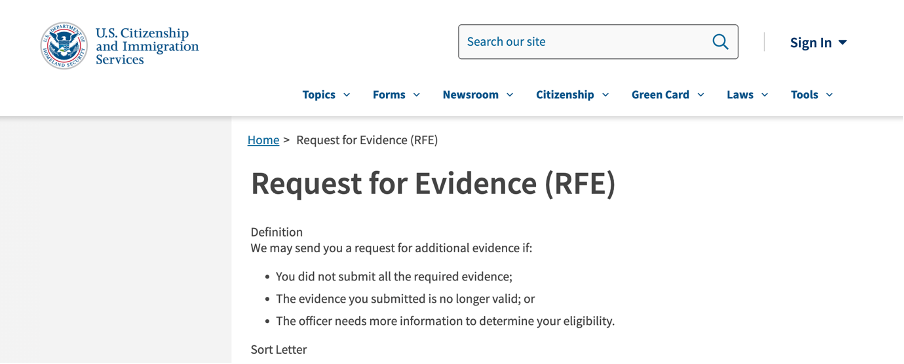
Translation:
We may send you a request for additional evidence if:
- You did not submit all required evidence;
- The evidence you provided is no longer valid; or
- The officer needs additional information to determine your eligibility.
We don't have exact statistics on how many RFEs are issued instead of approvals in percentage terms, but it is a widespread practice. Even strong cases receive RFEs, regardless of preparation. The possible reasons for an RFE and how to respond to them are discussed in detail below.
The NOID (Notice of Intent to Deny) scenario — a notice of intent to deny is not ideal, but compared to it, an RFE looks much better.
However, a Notice of Intent to Deny is not a death sentence either. On the page, we'll tell you about a person who received this scenario and ultimately obtained their Green Card.
Denial
The worst outcome, but also not the end of the world — get useful links and always remember, you can reapply!
On this official page you will find Q&A regarding appeal options Link
On this page — everything about decisions and the post-decision period Link
In general, a denial also means the case may need to be reassembled and resubmitted, paying the fees again. You can reapply an unlimited number of times.
Now let's move on to the reasons for RFEs and how to prevent this scenario. We've organized them by criteria (it would help if you've read all the criteria outlined on this resource before reading about RFE reasons). So, what might USCIS ask in an RFE, and what is better to provide right away when filing the case:
Possible Examples of RFE Reasons:
Critical / Leading Role (Criterion #8)
Don't ignore the organizational chart. This is frequently requested in RFEs.
Support letters often fail to provide specific examples showing how exactly the applicant's role rose to the level of leading or critical. USCIS expects it to be clearly visible where the applicant sits in the company hierarchy, and how the applicant differed from other employees.
Key things to demonstrate:
- The organization has a distinguished reputation.
- The applicant performed a leading or critical role.
- Their place in the company hierarchy must be clearly indicated.
Recommendation letters.
Discover new international opportunities right now
Complete your professional profile assessment in 2 minutes and find out:


The page you will be redirected to is exclusively related to building a professional profile and does not provide visa, immigration, or legal services and is in no way affiliated with the Knowledge Center educational platform.
After completing the test, you can return to this page or book a PR consultation with specialists we've verified.
For all questions regarding public profile building, publications, scholarly materials, interviews, and comprehensive professional positioning, we recommend the PR platform Persona System , which systematically works in this field, has been verified by us, and has signed the ethical memorandum on the .
On the page you can learn more about the Persona System platform, or choose other specialists who have also signed the ethical memorandum and work in this field.
Persona System provides exclusively PR and media support and does not provide legal or immigration advice.
We do not place paid advertising and do not receive payment from companies for placement in the "Specialists we recommend" section. This section includes only specialists and companies that have signed the ethical memorandum on the .
According to the USCIS Manual, letters from individuals who are personally familiar with the applicant's work and can confirm that their role in the project or company was leading or critical are especially valuable. Letters from employers who can describe the impact of the applicant's work on the organization are also accepted.
RFE Reasons: Media Articles (Criterion #3)
What experts recommend paying attention to when submitting publications:
- If there is a media kit, many people include it and mention it in the description.
- SimilarWeb is often used by attorneys to evaluate website traffic — it's worth adding a link to the statistics.
- Describe the publication's audience — how many readers, what topic, what niche it covers.
- It doesn't have to be a traditional licensed media outlet — large online platforms with significant audiences also qualify.
A common reason for RFE is that articles don't list the author. If there's no journalist byline — USCIS cannot verify the material's authenticity. Clear indication of the author, publication date, and article title is described in USCIS instructions.
Key points to prove:
- The article must be specifically about you and your activities.
- The title, date, and author must be clearly indicated.
- The publication must appear in a major or professional outlet (e.g., industry-specific media).
RFE Reasons: Unconvincing Work Plans in the U.S.
This is not a criterion from the criteria list, but we wrote about it in detail in the section.
USCIS checks whether the applicant has clear intentions to continue working in their professional field in the U.S.
The regulations state: it's not necessary to have a specific job offer, but you need to submit clear evidence that you plan to continue activity in the same field.
You need to provide:
- A letter of intent from a U.S. company or partner.
- A detailed business plan describing your areas of activity in the U.S.
If the letter doesn't indicate that it's a full-time position, USCIS may question the seriousness of the applicant's plans. Wording like "contractor" or "freelance" may be insufficient.
RFE Reasons: Scholarly Publications (Criterion #6)
USCIS requires clearly showing that you are the author of scholarly articles.
For this you can submit:
- Search results from platforms such as Google Scholar or SciFinder, showing the applicant's name as author, article title, and journal.
- Hard copies of publications or pages with authorship data.
Avoid submitting articles without a publication date or ISSN — USCIS may not recognize them as credible.
Don't forget to include:
- URL link to the article page.
- Journal name.
- Publication date.
- ISSN number or other unique identifier.
- Google Scholar link to confirm authorship.
How to Avoid an RFE: Judging (Criterion #4)
USCIS often accepts judging evidence when it's properly documented.
To avoid a request for additional evidence, prepare a complete document package:
- Official invitation to serve as a judge or expert.
- Letter confirming participation in a jury or expert panel.
- Event program listing the applicant as a judge.
- Thank-you letter or official certificate from organizers.
- Media publications about the event or the applicant's participation.
Additionally, you can submit:
- Reviews performed by the applicant.
- Copies of articles the applicant evaluated.
- Letters from editors or organizers confirming the applicant's contribution.
All information below is summarized from public sources and typical RFEs from 2023–2025. Every case is unique, and a proper response to an RFE leads to approval in 85–95% of cases (according to unofficial statistics from attorneys we've spoken with).
Disclaimer
The "Knowledge Center for O1 and EB1 Talent Visas" platform is an independent informational resource created solely for educational and informational purposes.
We are not lawyers, a law firm, or accredited immigration representatives and do not provide legal or immigration advice.
All information on the site is general in nature and based on open sources.
Information published on the site may be summarized, simplified, or incomplete. We do not guarantee its completeness, accuracy, or timeliness and are not responsible for any actions, decisions, or consequences that may arise from the use of this content.
Before submitting any documents or making important decisions regarding immigration procedures, consult a licensed attorney in the United States if needed.
Materials published on the platform may be distributed for non-commercial purposes with attribution to the source.
Please include a warning that these materials do not constitute legal advice and do not guarantee approval of any visas or petitions.
By using this site, you confirm that you have read the terms of this disclaimer, understand that all materials are for reference only, and agree that the Knowledge Center for O1EB1 Talent Visas bears no legal or other liability for any use of the published information.
The platform is not an official resource of the U.S. government or USCIS and has no formal affiliation with them.
This project aims to combine knowledge, experience, and open sources to help professionals better understand their opportunities. However, each path is individual. If in doubt, consult professionals.
By using this platform, you confirm that you have read and agree to our Terms of Use, Privacy Policy, and Legal Disclaimer, available in the respective sections of this resource.